

Finding and retaining top talent has never been more competitive. Today’s workforce is looking for an employer that understands life exists beyond their job title.
Work-life balance is one of the biggest deciding factors when evaluating employment opportunities, but it can’t live solely as a company value or a bullet point on a benefits page. Candidates are evaluating your organization long before their first day, and one of the first things they notice is your workplace itself. The layout, office furniture, and workplace design all tell a story about how employees are expected to work and, more importantly, how they’re cared for while they do it.
A thoughtfully designed office isn’t simply about aesthetics. It’s a competitive advantage that helps organizations attract talent, improve employee wellbeing, and create an environment where people can perform at their best which starts with wanting to be there in the first place. Here are four workplace spaces that have quickly gone from a “nice to have” to an essential.
1. Mother’s Rooms: Investing in Employees Who Invest in Everyone Else

Working mothers bring some of today’s most sought-after leadership qualities to the workplace. In fact, Bright Horizons’ Modern Family Index found that 91% of employees believe working mothers bring unique leadership skills, while 89% say mothers in leadership bring out the best in employees. Despite this, 72% of working parents believe women are still penalized professionally for starting families, a phenomenon commonly referred to as the “motherhood penalty.”
Supporting working mothers extends beyond compliance and is an important factor in retaining talented employees who often excel in adaptability, prioritization, communication, empathy, and problem-solving.
A dedicated mother’s room gives employees a private, comfortable space to pump or breastfeed without feeling isolated or forced into using a shared office, conference room, or restroom. It communicates something equally important: your workplace recognizes that employees don’t stop being parents when they walk through the front door. Even employees who aren’t parents today can recognize that their employer is planning for the different stages of life they may experience in the future.
From a workplace design perspective, these rooms should include comfortable lounge furniture, power access, refrigeration, a sink when possible, acoustical privacy, soft lighting, and calming finishes that help employees recharge during an already demanding part of their day.
2. Outdoor Spaces: Designing for Better Thinking
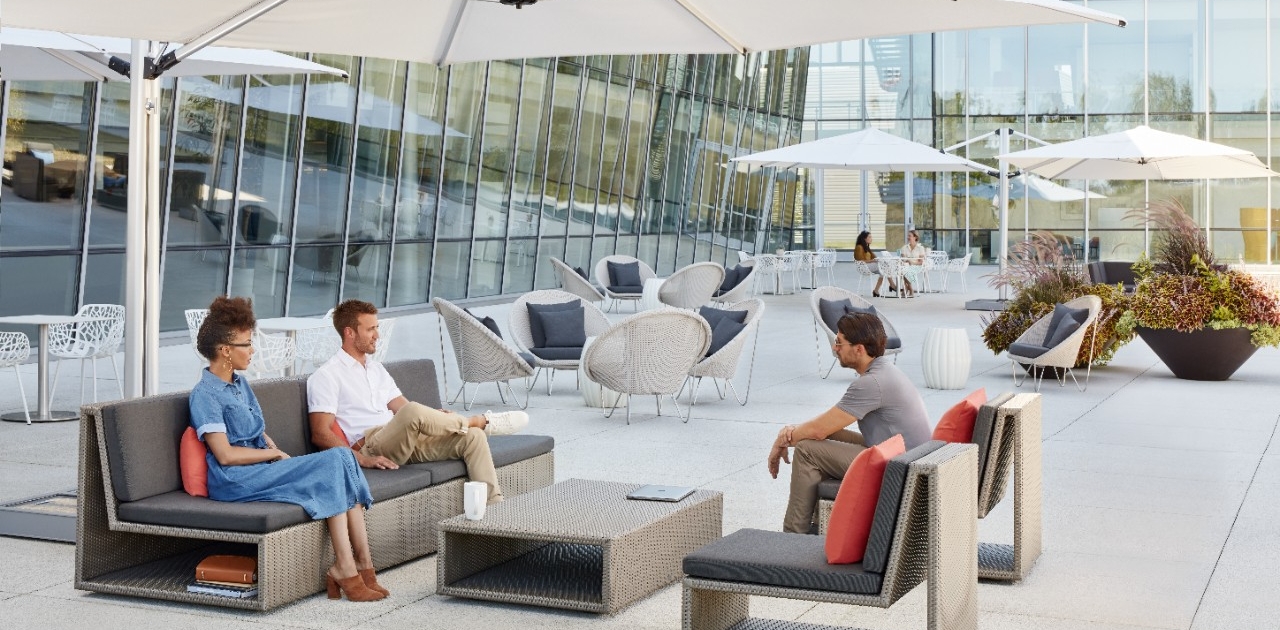
Creative and focus work demands constant concentration, creativity, and problem solving. The challenge is that our brains simply weren’t designed to spend eight hours under artificial lighting staring at computer screens.
Research consistently shows that spending time outdoors reduces stress, lowers cortisol levels, restores attention, and improves memory and creative thinking. Experts also recommend spending at least 120 minutes outdoors each week to experience measurable improvements in health and wellbeing.
Outdoor workplace spaces give employees an opportunity to reset mentally before returning to focused work. Whether it’s taking a lunch break, holding an informal meeting, or simply stepping outside between projects, these moments of recovery often lead to better productivity than trying to power through mental fatigue.
Not every organization has year-round ideal weather. Places like Alaska or Hawaiʻi experience two very different climates which create different challenges. Fortunately, workplace furniture has evolved to accommodate this flexibility. Commercial furniture designed for both indoor and outdoor environments allows organizations to quickly reconfigure spaces based on seasonal conditions while maximizing the use of patios, lanais, courtyards, terraces, or covered outdoor areas.
3. Rest Spaces: Productivity Requires Recovery
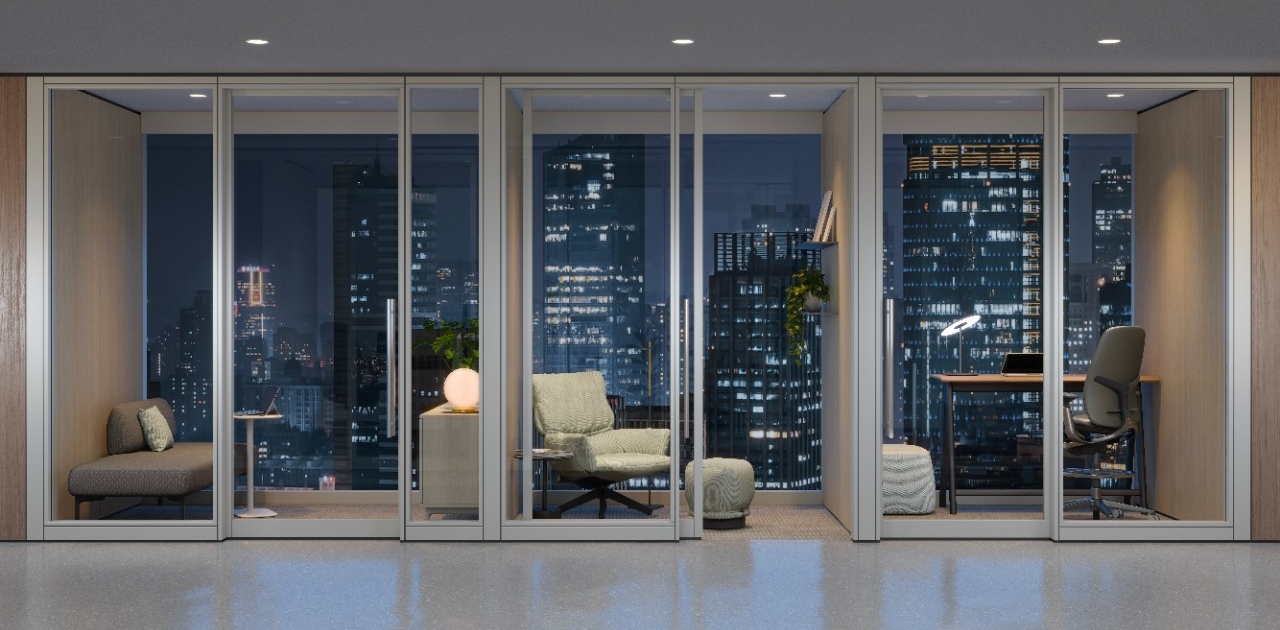
One of the biggest misconceptions in workplace culture is that more time at your desk equals more work accomplished.
In reality, research has found that happier employees are 13% more productive, and employees who regularly step away from their work maintain better focus and energy throughout the day.² For today’s workforce, where much of the workday is spent in front of multiple screens, experts commonly recommend taking a break every 50 to 60 minutes to reduce cognitive fatigue.
Dedicated rest spaces provide employees with somewhere to disconnect before jumping back into their next task. Unlike cafés or collaborative lounges, these environments are intentionally designed for quiet recovery rather than conversation.
Effective workplace design for rest areas often includes comfortable lounge seating, soft textures, dimmable lighting, calming colors like muted blues and greens, acoustic separation, and biophilic elements that help reduce stress. Spaces designed purposely for rest give employees a place to recharge, supporting greater focus, creativity, and productivity when they return to their work.
4. Quiet Zones: Supporting Focus in an Open Office

Collaboration has become a defining feature of the modern workplace, but collaboration without concentration creates a different problem.
Open offices make spontaneous conversations easy, yet they also introduce constant distractions. Phone calls, meetings, and nearby conversations all compete for employees’ attention, making deep focus increasingly difficult. According to workplace research, 74% of employees say having dedicated spaces for both quiet work and collaboration would make them happier to spend time in the office.
Rather than abandoning open offices altogether, organizations are creating balance by introducing dedicated quiet zones throughout the workplace.
These spaces can take many forms, including enclosed focus rooms, acoustic office pods, library-style work areas, phone booths, or neighborhoods separated from high-traffic collaboration areas. Paired with thoughtfully selected workplace furniture and acoustic solutions, these environments allow employees to choose the setting that best matches the work they’re doing.
Designing for People Is Designing for Performance
As organizations compete for top talent, workplace design has become one of the clearest expressions of what a company values.
Mother’s rooms, outdoor workspaces, rest areas, and quiet zones all send the same message: this organization understands that employees are people first. They have families, need moments to recharge, require spaces to focus, and perform their best when workplace design supports the realities of modern life.
Today’s workforce notices the details. The organizations attracting and retaining top talent are creating workplaces that acknowledge how people actually work, recharge, and balance their responsibilities. Beyond good design and a nice to have, they’re a reflection of company culture, values, and a long-term investment in the people who make the organization successful.
References
- Bright Horizons. Modern Family Index: The Motherhood Penalty in the American Workplace. https://investors.brighthorizons.com/news-releases/news-release-details/modern-family-index-shows-real-motherhood-penalty-american
- University of Oxford Saïd Business School. Happy workers are 13% more productive. https://www.ox.ac.uk/news/2019-10-24-happy-workers-are-13-more-productive
Hawaii
Corporate Headquarters
1738 Silva St
Honolulu, HI 96819
Phone: (808) 847-0911
Alaska
Office & Showroom
4401 Business Park Blvd., N-42
Anchorage, AK 99503
(907) 202-7069
Legal
About
Markets
Products
Resources
Connect
 |  |